Capsule-Making Machines & Production Lines
Fully automatic lines and auxiliary machines that make the empty capsule shells themselves — not filling machines that put powder into capsules. Our own capsules are made on the same equipment.
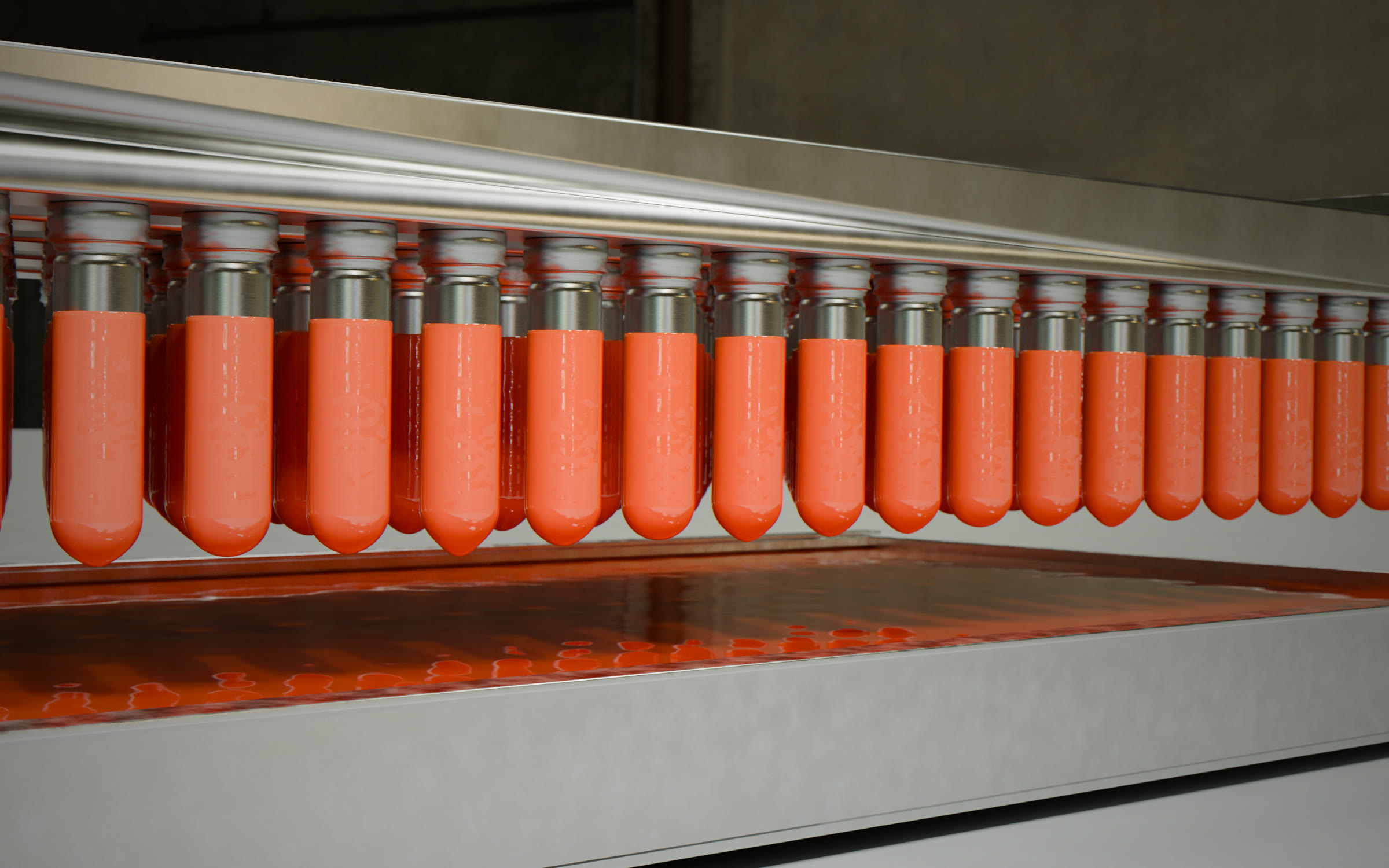
3D illustration: a stainless pin bar lifted from the dipping pan. The gel film on each pin dries into a capsule cap or body.
Fully Automatic Hard Capsule Production Line
One line runs dipping, drying, stripping, cutting and joining in sequence, and what comes off the end is finished capsules with cap and body already joined. Gelatin and HPMC set in different ways, so whether one line can make both depends on the HPMC process — see the machine FAQ. Our lines make gelatin capsules and gelling-agent HPMC capsules.
| Capsule sizes | 00–5 (change pin bars to change size) |
| Output | 1.5–3.3 million a day, by model |
| Materials | Gelatin / HPMC |
| Line dimensions | about 18.3 × 2 × 2.65 m (length can be customised) |
| Total power | 40–55 kW, 380 V three-phase |
| Control | Motion controller with full servo drive, touch-screen HMI, remote monitoring |
| Operators | 2–3 per shift |
Request a Line ProposalBook a Factory Visit
Our own capsules are made on these lines. You can ask to see the lines running (book two weeks ahead) or, if you can't travel yet, book a live video tour. See delivered projects ↓
Download the product catalogue (PDF)8 pages · 0.9 MB · capsules, size chart, machines and terms
Dipping Station: Lift, Dip, Flip
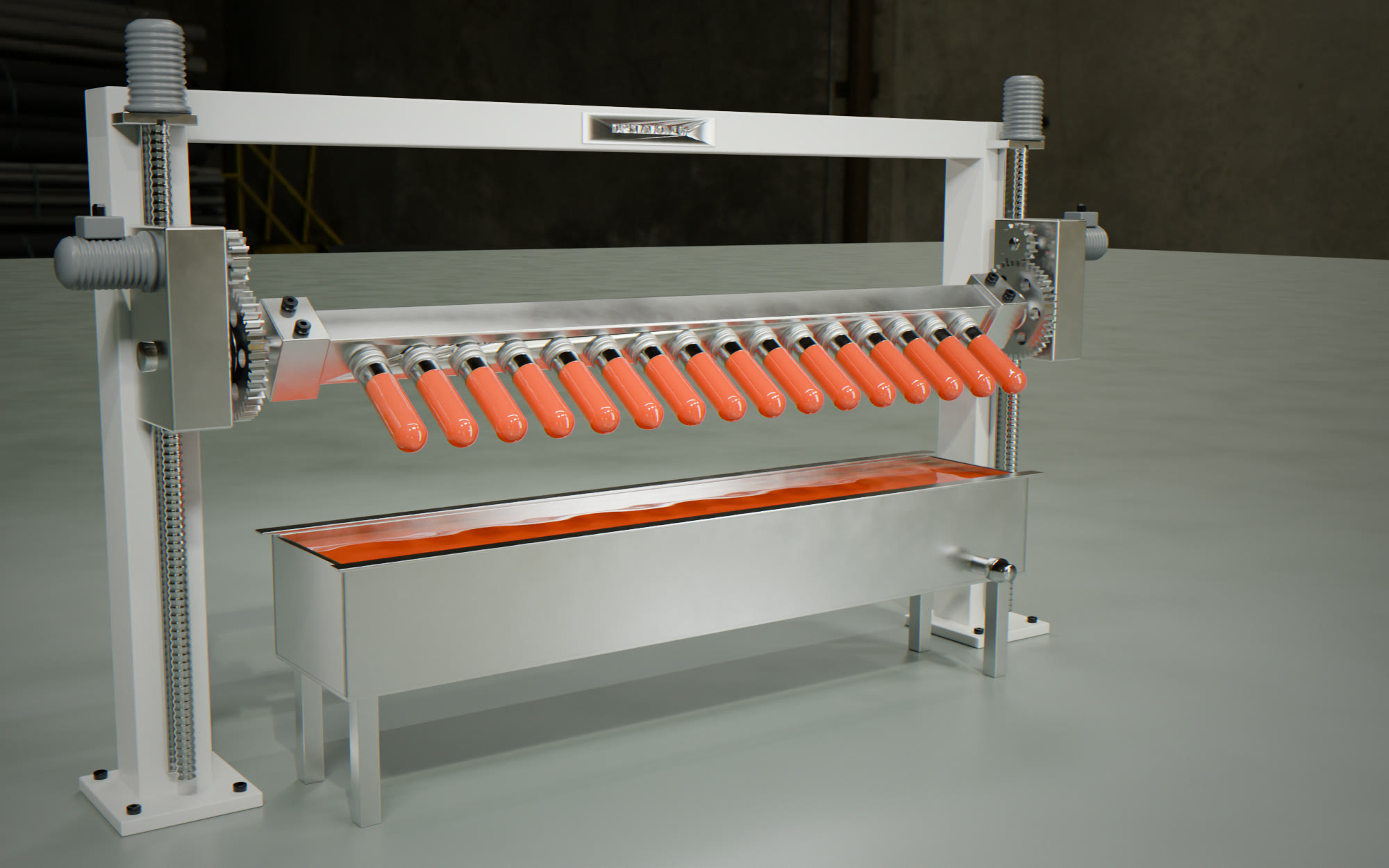
An illustrative 3D model of one dipping cycle: the pin bar lowers into the dipping pan, lifts out, then turns over 180° so the pins point up and the gel film levels out before it sets. Drag to rotate, or press “Play cycle”.
Loads on request to save mobile data
Loading 3D model…
Illustrative model scaled to size-0 body pins. The columns, ball-screw lift and gear-driven flip are there to show the motion only; the actual machine's structure, drives, pin count and bar length are set out in the line proposal.
How Hard Capsules Are Made
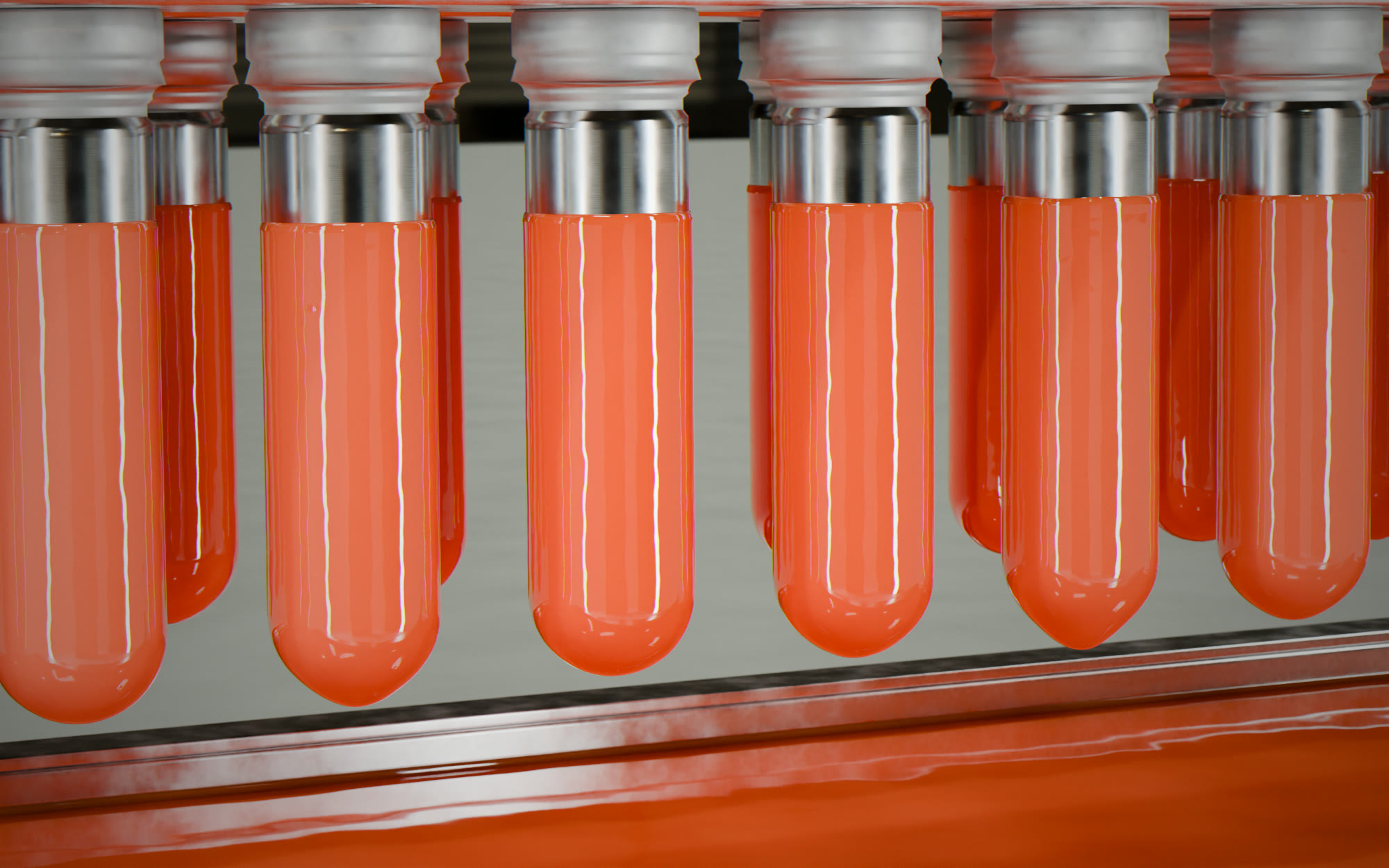
Hard capsules are made by pin dipping. Rows of stainless steel pins are dipped into the gel and come out coated with an even film. The film is dried, stripped off the pins and trimmed, and each cap is joined to its body.
Gel preparation
Dissolve gelatin or HPMC, add colourants and opacifier, de-aerate
Pin dipping
Stainless pins dip into the gel; caps and bodies form separately
Spinning & setting
Pins rotate for an even wall while the film sets (gelatin by cooling; HPMC depending on the process)
Drying
Drying chambers (upper and lower kilns) with controlled temperature and humidity
Stripping & cutting
Caps and bodies stripped off and trimmed to length
Joining
Caps and bodies pre-locked into complete capsules
Inspection & printing
Defects rejected; printing if required
Packing
Counted, packed, sampled and released
Auxiliary Machines & Spare Parts
Beyond the main line, a capsule plant needs gel preparation, printing, inspection and drying/HVAC equipment, plus mould pins and wear parts for day-to-day running. Single machines and spare parts can be quoted on their own. All of these can be supplied on their own.
Gel Melting System
Melting tanks, vacuum de-aeration and heated holding to feed the line.
Get a quote →Mould Pins & Pin Bars
Stainless steel pins and bars for each capsule size, sold as spares.
Get a quote →Capsule Inspection & Sorting
Vision inspection rejects broken, dented or off-colour capsules.
Get a quote →From Plant Layout to Production
For new capsule plants, our engineers follow through from layout and configuration to installation, commissioning and training.
Consultation
Capacity, products, site
Design
Layout and configuration
Build & FAT
Factory acceptance test
Installation
On-site engineers
Training
Process and operator training
After-sales
12-month warranty, one year of wear parts, remote diagnosis
Machine FAQ: lead time, utilities, gelatin vs HPMC and more →
Documents for Acceptance and Equipment Qualification
If your capsules will go to pharmaceutical customers, they will audit your plant, and the line will need equipment qualification (IQ/OQ/PQ). These are the documents buyers usually expect from the machine maker at acceptance and qualification. Write the ones you need into your URS or the technical agreement before you sign. Our lines come with the operating manual, electrical drawings, spare parts list and FAT report, in Chinese and English.
Factory & site acceptance
- Factory acceptance test (FAT) protocol and report
- Site acceptance test (SAT) protocol and report
- EU Declaration of Conformity, for lines going to the EU
Equipment qualification
- Design documents for DQ: specifications, layout drawings and a URS traceability matrix
- IQ/OQ protocols and executed records
- Material certificates for gel-contact parts
- NSF H1 food-grade lubricant certificates
- Calibration certificates for critical instruments such as temperature and humidity sensors
Manuals & drawings
- Operating and maintenance manuals
- Electrical schematics, piping and pneumatic diagrams
- Spare parts list, with wear parts and part numbers marked
- PLC and HMI program backups
Lines Already in Production
Before you commit to a complete line, the best evidence is one already running in another plant: which country, which capsules, what was supplied, how long it has been in production, and whether you can speak to that customer or see it running.
Want projects similar to yours?
Tick “Delivered projects” when you send your enquiry and tell us your country and the capsules you plan to make, so we can match similar projects; the reference list comes with your line proposal.
Project photos and videos are available, and reference calls can be arranged with the customer's consent.
What to Confirm Before Buying a Line
Delivery, acceptance, installation and training, warranty and payment; the formal quotation and contract apply.
Delivery time
- Complete line
- 3–4 months from contract to shipment
- Auxiliary machines / spares
- 4–6 weeks
Factory acceptance
- Before shipment
- Factory acceptance test (FAT) (done for every line before shipment)
- Attend in person
- Yes — book two weeks ahead
Installation & training
- Installation
- On-site installation and commissioning by our engineers (included in the quotation)
- Training
- Process and operator training (on-site operation and process training, typically 7–10 days)
- Travel & lodging
- paid by the buyer
Warranty & after-sales
- Warranty
- 12 months
- Spares & remote support
- one year of wear parts supplied with the line; diagnosis by video or remote monitoring
Payment & pricing
- Payment terms
- 30% on contract, 60% before shipment, 10% after acceptance
- Price terms
- EXW, FOB Qingdao, CIF
Power & certification
- Voltage / frequency
- 380 V / 50 Hz three-phase as standard; built to your local supply on request
- CE marking
- EU Declaration of Conformity available
Other questions? Read the machine FAQ →
Planning a new capsule plant or more capacity?
Tell us the capsules you plan to make, target output, site status and timeline — a floor plan can be attached to the form — and we will reply within one working day. Want to see the machines running first? Book a factory visit.
Can't travel yet? Book a live video tour first →